Transcript
Aldemis services introduction
Alexander Mihalcea (00:00)
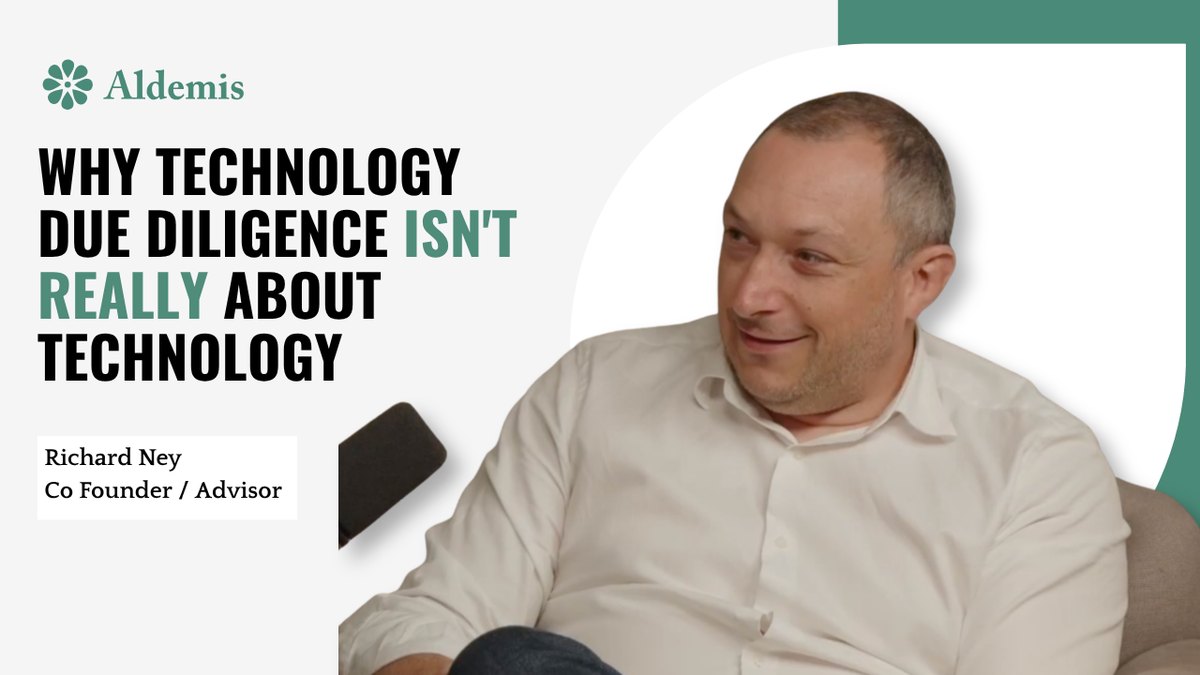
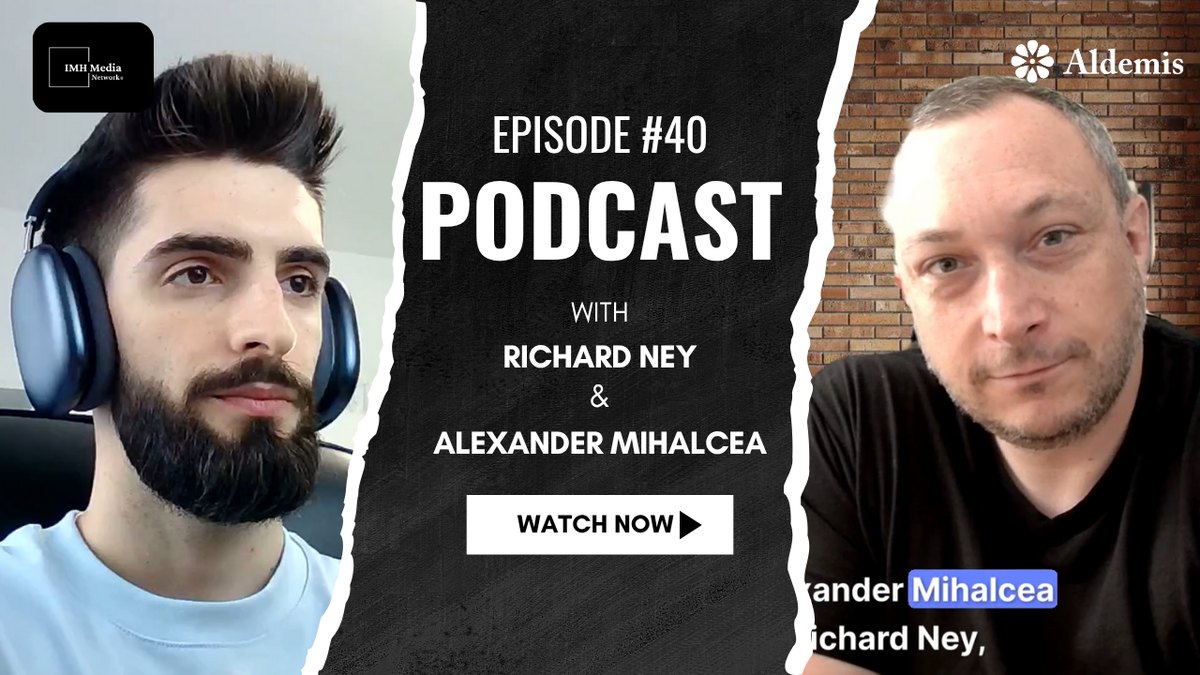
So, welcome everyone, I'm Alexander Mihalcea and today we're joined by Richard
Ney, Managing Consultant of Aldemis. Thank you for being here.
Richard Ney (00:08)
No worries, thanks for having me.
Alexander Mihalcea (00:12)
Before we dive in, could you give us a quick overview of what Aldemis does?
Richard Ney (00:17)
Sure, Aldemis is a general consultancy, mostly focused on fintech. The main purpose is
to make sure that tech and business fully align. I was having a number of discussions with CEOs and CTOs that feel that
sometimes there are some break in the communication. I launched Aldemis fairly recently.
Until a month ago, I was the CEO for a fintech called Lerex, which was playing in the Banking as a Service space. So Aldemis is really capitalising on my technology background, but as well on my CEO experience to make sure that tech delivers for business.
Alexander Mihalcea (01:01)
And what inspired you to launch it? Was there a specific moment or experience
that sparked this journey?
Richard Ney (01:09)
I've always used Aldemis as a consultancy vehicle to some extent from way back. But I
think the reason to really relaunch it is the growing frustration that technology wasn't used to its full potential.
There was a number of situations where I could see CTOs on board tables struggling to get some of the important tech
concepts understood and getting the right buy-in from the rest of the board. And equally, I could hear CEOs being
concerned about tech being built for the sake of tech, and not for the sake of return on investment. Because I've
always been really passionate about both tech and business, I wanted to help bridge that gap.
Making sure everyone understood what everyone else is doing and pushing in the same direction.
Alexander Mihalcea (02:15)
And as a whole, what drew you to focus on fintech and the financial sector?
Richard Ney (02:21)
We do focus on fintech, but you're right, it's the larger financial piece. To give a
bit about my background, I spent my early career building stock exchanges and trading platforms, as well as core
banking systems. I've always been in that kind of larger financial ecosystem, but more recently into fintech. The thing
we really focus on is situations where you need low latency or high throughput, or a high level of automation.
Something we are being asked a lot about is: how do you reduce your cost of operation or cost of customer onboarding
through automation and through technology? So that's really the pieces that we focus on. But obviously it extends to
some situations where we would help around investor funding and fundraising from that technology aspect.
Alexander Mihalcea (03:20)
And what's been your most valuable learning experience in this industry?
Richard Ney (03:27)
That's a good question. I think there are two things that spring to mind: from a
business point of view, it's the usual misconception that if you build it well, customers will come. That's never been
my experience. You can build a great product, but if you don't market it, if you don't talk about it, customers will
not come.
I think sometimes, especially in fintechs that are led by technical founders, they build an amazing piece of tech, an amazing platform, and think that the rest will fall in line. It will definitely help, but there are other things you need to do to make sure that you're growing at the pace you want.
Another learning that springs to mind is being careful about anticipating what customers want. I've seen myself build solutions where I was sure people would want it. I spent time building something and actually customers wanted 10% of it. When they start using it, or when you start having discussions, you realise that it's merging into another direction.
So I would encourage going back to the MVP: just build the strict minimum, speak to your customer and build on that customer need. Experience is more important than just trying to anticipate as much as possible.
Alexander Mihalcea (04:59)
So let's go back to when you first started. What major challenges or gaps did
you see in the market that made you think this needs to be solved?
Richard Ney (05:13)
It's going back to those board discussions around miscommunication and frustration.
One clear example of that is I was sitting on a board about 18 months ago just as a general advisor and observer, and
there was a discussion between a chief technical officer and a chief financial officer, and to some extent with the CEO
as well.
There was a lot of background, and some political baggage in that discussion, but the discussion became about the chief technical officer having to justify what a DevOps engineer was doing. The CEO was a non-technical founder, the CFO wasn't technical, and the CTO really struggled to articulate what DevOps is and why they are needed.
In that case, the salary bracket might be slightly different than other types of technologist, and it became really apparent that there was a gap. From my point of view, wearing both the technical and business hat, I think what the CTO wanted to do was best for the business, but the CTO struggled to get the traction.
So after that board I reached out to the CFO and had an off-the-record discussion, and reached out to the CEO as well. That decision was overturned fairly quickly.
But that's really when I realised the main challenge the CTO was facing at the time was that the CTO was still using a number of technical words to describe the situation, where I just went back to layman's terms, pure business. I really focused on cost saving with the CFO. I really focused on the business benefit to the CEO.
And that's what I think helped unlock that discussion. So that was one of the first moments where I realised, well, wait a minute, there are still some of those gaps happening today in decent mid-size businesses.
Alexander Mihalcea (07:25)
Could you elaborate on why the existing solutions weren't meeting these
needs?
Richard Ney (07:34)
Yes, I think if you look at a lot of consultancies out there, they focus on one of the
aspects. They focus either on technology or on business. I don't know of many consultancies that really cover both
sides, really look at how both work together.
They focus on how you build technology, do you deliver good technology, and things like project management. But at board level, there isn't a clear integration with the C-suite. CEO, CFO, COO, some of the advisors — everyone needs to understand what is going on and be on the same page to be comfortable that they're spending the right money in the right places.
What we're seeing on the market today is budgets getting tighter, it's a bit more difficult to raise money. People want to make sure that they're cutting the right area, and making sure that you're addressing the right thing is really important. Then you have the consultancies that focus really much on the business side, but often struggle to articulate what they need from the tech team. The CTO brief becomes very, very high level and there's room for misalignment.
Most CTOs that are with these institutions are really, really good, but still it doesn't help. Aldemis can help them a little bit more to focus on the right thing. I think the current solutions don't go far enough either way, either not far enough with the business, or not far enough with the technology.
Alexander Mihalcea (09:23)
Walk us through how Aldemis addresses these challenges. What makes your
approach unique?
Richard Ney (09:31)
I think the really unique piece with our approach is that every single challenge,
decision, question, we always go back into how does that benefit the business. You're about to spend a pound in
technology. How do we demonstrate that that pound in technology is right? How is that going to contribute to more than
a pound in revenue, valuation, and so on?
Richard Ney (10:00)
A lot of businesses are still trying to grow their valuation effectively, either
through revenue or other metrics. So how do you make sure that every part of your technology directly contributes to
your valuation? That's really the focus we have. If a decision is right for the business, it's right for the technology
as well.
Interestingly, when we first engage, sometimes there is a bit of a question mark on the technology side of — wait a minute, we're going to have to justify, we're going to be asked more questions. But actually, when we start engaging, it's not the case. What we find is that when you explain to a technology team that this piece of work is going to really contribute to the business, and this one less so, everyone wants to help the business. The team naturally aligns to the pieces that are really contributing.
I'll give you an example. We joined, probably five or six years ago now, a business effectively to improve the business's perception of a development quality issue. It was an old piece of technology. The software had probably been around for 10 or 12 years, wasn't really motivating to work on, there weren't many new features, it was pure BAU. The tech team was motivated, but not greatly motivated. Because of that, there was a perception of a quality issue within the dev team.
The reality is that when a project fails, it's never just one team. So the issue was larger than that. But there was a perception that the tech team wasn't delivering. The first thing we did is we took the whole team into a room — about 25 people working on that old cash-cow product.
I asked the CEO and the Chief Product Officer to come in and explain where the product fit in the overall business. What they explained to the developers is that it was an old product, it was going to be retired, its shelf life was about three years still. But the product was currently contributing 80% of the business revenue. And when they articulated how important it was — you 25 people are generating 80% of the revenue for the business, for the 300 people in the organisation — that's where 80% of the revenue is coming from. When there is a critical bug happening, that revenue is going to decrease. So the fact that you're fixing bugs quickly allows us to maintain that. Then they explained the plan to move into a new product and what was going to happen post three years.
Just that message of saying, you 25 people are generating revenue for 80% of everyone here — that made a massive difference in the approach. Mapping technology with business is extremely, extremely powerful.
Alexander Mihalcea (13:46)
When you talk to potential clients, what's the biggest misconception they
typically have about what you do?
Richard Ney (13:57)
A typical misconception is the one I described, that it is going to annoy the
technologists, that it is going to become a challenge or a barrier for them. That's the biggest misconception, because
usually we are selling mostly to CEOs and COOs. We're able to explain that, but even when we sell to a CTO, we're able
to explain from past projects that actually it's not the case. We are really able to help both sides. If I look at the
example of the DevOps engineer, bridging the gap also helps the CTO.
One of the differences in the approach from a technology point of view is that technologists don't have to explain to us why we need to address technical debt. They don't have to explain the benefit of test automation. They don't have to explain some of those basic tech concepts. We get it. My background is as a developer. We're developing technology all the time. We can go straight to the business and help articulate those benefits.
The second misconception is about our cost. How are we going to get the return on investment? That one depends on the size of the business. If it's a business of less than 10 people and the revenue is very small, we probably won't engage to start with, because we feel we won't deliver the value. For slightly larger businesses, making sure the business fully leverages technology is a real benefit. In some projects we are able to cut onboarding time by 80%. We were able to drastically reduce operational costs. So we can demonstrate return on investment.
Aldemis success stories
Alexander Mihalcea (16:08)
Could you share a specific success story of a client who saw significant
results?
Richard Ney (16:16)
There are a few that spring to mind. Going back to the team generating 80% of the
revenue, we primarily engaged because the customer had started a regulatory project. I think we engaged in November and
the customer needed the project to go live in March or April — roughly a six-month project.
Our customer had realised very quickly that things were going wrong. They had started the project three months before speaking to us and they already had forecast a six-month delay. We engaged and were quite drastic around what could be done and what could not be done. I think that's another difference in our approach. We are not afraid of having difficult discussions so people know exactly what's feasible or not.
Effectively, through our engagement they managed to hit their timeline, and I remember the whole business thought it was never going to be feasible. We were able to meet the timeline and they didn't have to decommission anything. If the project had failed, they would have had to switch off that 80% of revenue until we could deliver. So there was a very large impact for them.
Another success story, on a smaller scale, was a new startup a couple of years ago. There were two co-founders, one business, one technologist, and they had an argument. The technologist left with the tech team, and the business person was left with the source code and a bit of documentation, but not much. In order to keep customer contracts, they had to be live within three months.
Richard Ney (18:48)
That was someone I knew personally, so we were able to engage very quickly. We jumped
in, recovered from source code, fixed some bugs and managed to get live in three months.
Another example is all about reducing the cost of onboarding and automation. Not through Aldemis, but prior to that, a project I led was automating the testing for a stock exchange. What had happened is that the stock exchange had ended up in a situation where they were changing their whole client API.
Richard Ney (19:46)
They only got access to the new API on the Monday and it had to be retested and live by
the Friday. Can you imagine retesting a whole stock exchange? We knew three months prior that we would have to retest.
We spent a lot of time in those three months to automate everything. When the new API dropped on the Monday in the test
environment we were able to retest everything within two hours, get that to the provider, the provider was really quick
at fixing bugs, and effectively by the Wednesday all bugs had been fixed and the API was ready to go out.
It's really about what does the business need, how can we do that, and there's also an element of maybe you need to compromise on a couple of the nice-to-have points.
Broader industry trends in fintech
Alexander Mihalcea (20:48)
Looking at the broader industry, what key trends are you seeing emerge?
Richard Ney (20:48)
In the fintech industry, the massive one that everyone talks about is AI, but from what
we're seeing, the fintech industry is still not leveraging it. There are a few businesses at the periphery of it that
use AI extensively, but as a whole, we are not seeing a massive shift to AI. We are seeing some strong element of
automation being adopted — but automation, not AI. I'm sure it's going to come.
The biggest trend we're seeing at the moment is around regulatory changes. We saw things like the APP fraud compensation coming into place at the end of last year, which had a bit of an impact. Not as much as we thought in the industry, but there was an impact.
Because of that, we saw the cost of payment processing increasing, and then people looking at automation to go back to a reasonable cost of processing.
As part of that, a number of people are talking about what we call FinTech 2.0. If you look at fintech today, they have taken a number of legacy processes and legacy software, built a very nice UI in front of it, and in a lot of cases that's great user experience. But the user experience is still backed by some of the old processes and old systems. The reason it's a problem is that it's a bit dysfunctional in places. That's where you see things like getting offboarded as a customer, or getting onboarded but blocked on the first transaction, or getting blocked and taking three weeks to explain to compliance why it's fine, or being offboarded with zero reason.
We're seeing a number of situations at the moment where SMEs get offboarded from their bank with no reason whatsoever. That's because all those processes are not quite working together. What we call FinTech 2.0 is that through AI and automation, we believe all of the teams — technology, compliance, onboarding — are going to work together, and therefore the decisions that get made are going to be more normalised, more homogeneous, the risk will make more sense and the decisions are going to be easier to address.
That's one thing we had built with Lerex: a platform which was fully real-time, highly automated, so all of that could work in a much more effective way.
Alexander Mihalcea (23:52)
What regulatory challenges are impacting the industry most significantly?
Richard Ney (24:02)
I think APP fraud was a big one. Again, we all expected almost the end of the world on
this one. It didn't really happen. I'm still not sure we've seen the end of it, but it's definitely not as big a problem
as we all thought, which is good.
One of the challenges on the regulatory element is the pace of change we've seen over the last couple of years, which has been very difficult for a lot of businesses to maintain. And as well, the disparity within the UK and Europe, especially in situations like crypto.
I was talking a little bit about AI. Similarly, it would be great to see more information from a regulatory body on what they're going to accept from an AI point of view, because you could have an AI fraud system in place, or an onboarding system, but is that going to satisfy the regulator?
So one of the challenges is going to be making sure that we understand what the regulator is happy to accept following those new types of approaches. It would be great to see more homogeneity between the UK and the EEA, because a lot of businesses operate across both jurisdictions. When it's not clear, it becomes difficult. We are seeing that in crypto, creating some real challenges because the frameworks are not the same.
Alexander Mihalcea (25:34)
What challenges do traditional financial institutions face in adapting to
fintech innovations?
Richard Ney (25:45)
One of the challenges, and this goes back purely to tech, is that if you haven't built
your business to leverage a technology stack properly, it's really hard to change.
It's also really difficult to adapt legacy systems, and it takes a lot of time. I spent a decent amount of time working for large banks, and it is difficult for larger companies to go back into true fintech innovation and start delivering fintech solutions. That's why we see a number of initiatives failing.
It's difficult for a number of reasons, all the way up to board-level considerations. I think what's going to happen is they'll start buying out, and we already see that happening. They buy out tech businesses rather than trying to build them. But then the question becomes, how do they integrate that as part of the ecosystem?
I think larger financial institutions are just going to become the backbone. They're not going to be customer-facing any more. They're going to be the mortgage provider behind a Revolut mortgage or a Starling mortgage, for example. They're going to become the backbone of those fintechs and it's going to go through a couple of layers before it reaches the end user. The reason it's going to end up happening is because what they do really well is traditional financial services, not user experience.
What are business owners getting wrong?
Alexander Mihalcea (27:54)
In your opinion, what are most business owners getting wrong when they're
trying to address this problem?
Richard Ney (28:05)
Not enough market research, either pre-launch or post-launch. I am still surprised that
I speak to businesses and I'm asking, okay, which feature are your users using the most? What do they want? What is
their biggest problem? Which is the stuff they like the most? They maybe have some ideas of those answers but they
don't necessarily have a clear answer.
Unless you understand clearly what your customers want, it's difficult. But more than that, how are customer needs evolving? Providing one thing very well to a handful of customers is very different from what customers will want when you're providing a service to a thousand of them. And those customer groups might evolve as your business grows. Your original group might not be the group you're servicing any more.
So you need to be very clear on what your current customers at this point in time like and dislike. I think they don't spend enough time on that.
Over the last five or six years, we've seen at the beginning of that period a lot of investment going into fintech. So a lot of people are still trying to raise money on the back of ideas which didn't necessarily make complete sense, or they didn't have a clear rationale for why it was going to work, how they were going to generate money.
It's happening a bit less now, but it's still happening a little. What we're going to see is new fintech services that truly generate money, that are truly viable. But for that to happen, there needs to be a cycle of technology innovation.
When you look at fintech today, the cost of onboarding a customer is still very high. In some businesses, the cost of retaining and servicing a customer every month is still very, very high. Unless you use automation to solve those challenges, some businesses will never be able to be profitable, because their unit economics are just wrong. So I think we're going to see more adoption of automation and AI, and that's going to drive business models that can be truly profitable.
Alexander Mihalcea (30:29)
What advice would you give to business owners who want to stay ahead of these
changes?
Richard Ney (30:36)
Watch the market, understand really well what your customers want, and be very, very
careful about your unit economics — look at ways to drive them down whilst providing a very good service.
Don't be afraid to collaborate with what look like competitors. In previous businesses my competitors have been very useful. My first exit was a sale to a competitor. It was a very successful transaction.
IMH Media Network
Thank you to Alexander Mihalcea, founder of IMH Media Network, for hosting us.
Wondering what this means, in practice, for your business? Contact us to discuss.