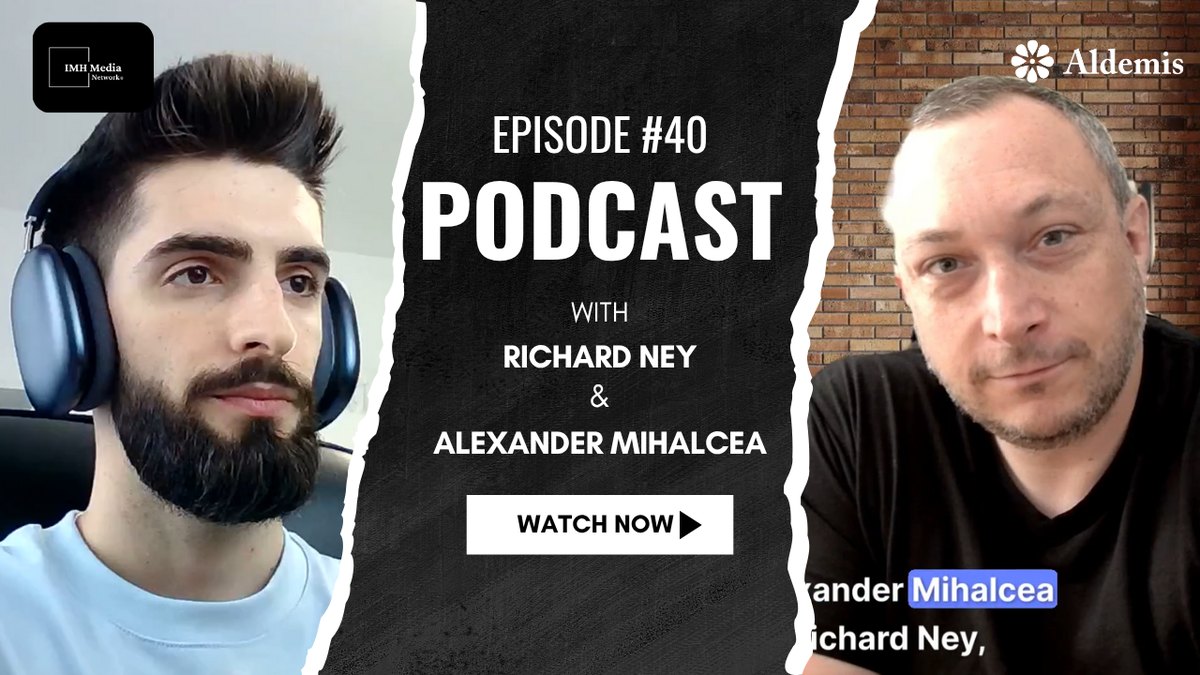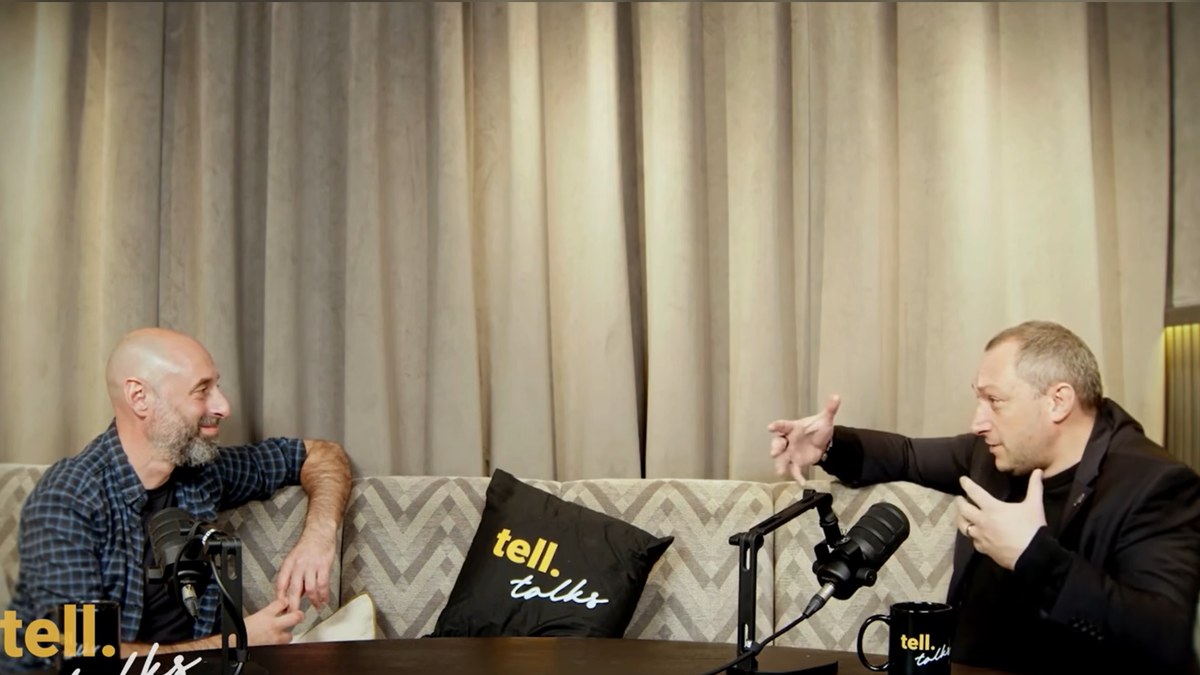
I recorded an episode of tell.talks recently with David Monty, and one question kept coming back in different forms: how do you know whether the technology you are building is actually serving the business? It is the question Aldemis exists to answer, and I have been on the wrong side of it often enough to have some sympathy for everyone involved.
David is a good person to be asked it by. He is the CEO and co-founder of tell., which provides managed open banking and account verification services to banks, EMIs and payment providers, covering Confirmation of Payee and Verification of Payee for over a hundred financial brands. It is the kind of business where the technology is the product and the regulation is not optional, so the gap between a clever engineering decision and a commercial outcome is fairly short. He also founded it alongside his CTO, Tony Poole, which turned out to be relevant to the part of the conversation I liked most.
Looking back at the conversation, three things stayed with me. One is a piece of work I did early in my career that I still think about. One is about the relationship between a CEO and a CTO. And one is about what happens to a development team when it finally understands why the work matters.
Six weeks on a matching engine
Early in my career I spent a lot of time building trading platforms, which meant spending a lot of time inside matching engines. A matching engine is the part of an exchange that pairs buy orders with sell orders, and the received wisdom is that it can never be fast enough. So when I was given the job of making one faster, I took it seriously. I spent about six weeks on it.
It was good work. The engine was meaningfully quicker by the end, and I was pleased with it. The problem was that nobody noticed. The volumes we were actually handling were nowhere near the point where the old speed was a constraint, and the bottleneck our clients complained about was somewhere else entirely. I had taken something that was already fast enough and made it faster, which on any honest reckoning is six weeks the business did not get back.
I do not think I was being lazy or self-indulgent. I was doing what engineers are trained to do, which is to improve the thing in front of them. What I had not done, and what nobody had asked me to do, was establish what the business would do differently if the engine got faster. If anyone had asked that question out loud at the start, the answer would have been "nothing much", and I would have been pointed at something else in the first week.
That is what overengineering usually looks like in practice. It is rarely someone building a cathedral for the fun of it. It is a capable person optimising the thing they can see and measure, in the absence of anyone telling them what the business is actually short of.
The CEO and the CTO should be challenging each other
The reason that question never got asked is the second thing we talked about. In a lot of businesses, the CEO and the CTO have arrived at a polite arrangement. The CTO does not want to bother the board with technical detail that will not land, so the technology gets summarised into a traffic light. The CEO does not want to look out of their depth, so they accept the traffic light and move on. Everyone is being perfectly reasonable, and nobody is being challenged.
I have sat on both sides of that table, as a CTO trying to explain why a piece of work was necessary, and as a CEO trying to work out whether I was being told the truth. The healthy version is noisier. The CEO should be asking what a piece of work will change for customers, for revenue or for cost, and should keep asking until the answer makes sense without any technical vocabulary in it. The CTO should be pushing back when the commercial plan assumes something the platform cannot do, and should be willing to say that a deadline is not achievable rather than discovering it later.
Neither of those conversations is comfortable, which is exactly why they get avoided. But a board where the CEO and the CTO never disagree in public is not a board that has got technology under control. It is usually a board where one of them has stopped listening and the other has stopped trying.
What changes when a team can see the business
The third story is the one I find most encouraging, because it is the easiest to fix.
I have been brought into teams that were described to me as underperforming. Delivery was slow, quality was patchy, and the mood was flat. In my experience that is almost never a capability problem. When I sat down with the engineers and asked what the business was trying to achieve that quarter, they could not tell me. They knew their tickets. They did not know what the tickets were for.
Once a team understands what the work is worth, the behaviour changes on its own. People start questioning requirements rather than silently implementing them. They flag the feature that nobody will use before building it, not after. They make sensible trade-offs about quality, because they can tell the difference between the thing that will embarrass the business in front of a client and the thing that will never be noticed. They stop spending six weeks on a matching engine.
None of that needs a reorganisation or a new methodology. It needs someone to explain the commercial picture to the people building the product, in plain language, often enough that it sticks. It is remarkable how rarely that happens.
What I would take from it
If I had to reduce all of this to something practical, it would be three questions worth asking before any significant piece of technical work starts.
What will the business do differently if this works? If the answer is vague, the work is not ready to start. That is not a reason to cancel it, but it is a reason to go and find the answer first.
What is the actual constraint? Not the thing that is most interesting to improve, and not the thing that is easiest to measure. The thing that is genuinely holding the business back this quarter.
Who would tell us if this was the wrong priority? If nobody in the room is positioned to say so, or incentivised to say so, the answer is probably nobody, and that is worth fixing before the six weeks start.
Technology that delivers business value is not usually a matter of better engineering. Most of the teams I meet are perfectly capable of building what they are asked to build. The difficulty is in the asking.
If you are not sure whether your technology spend is pointed at the right problem, we would be very happy to help. Click here to contact us.